


South Dakota National & State Parks: Badlands, Custer & More
Updated: Aug 13
Please refer to the 1st post in this 2 part series for an overview of my experiences visiting National Memorials and Monuments during our early summer vacation in South Dakota and Wyoming.
This post is focused on my experiences at State and National Parks.
We kicked off Day 2 of our trip with plans to visit the Badlands, but clouds and rain pushed us in another direction—underground. With weather forcing us to pivot, we adjusted our schedule and decided to visit Wind Cave National Park.
Arriving at the visitor center shortly after opening, we hoped to secure cave tour tickets. Morning spots were already booked, but we were able to reserve the 3:30 PM Natural Entrance Tour—which gave us about six hours to explore the park above ground. Little did we know just how memorable those hours would be.
As we entered the park, we experienced one of the most up-close wildlife encounters of our lives: a group of bison grazing less than 10 feet from our car. Like many others, we pulled over to take it all in. I joked with my wife and son that they should warn me if the bison started moving toward us—just in case I needed to hit the gas. But honestly, these incredible animals couldn’t have cared less about us. They grazed, trotted, and wandered about their day—on their land and on their terms.

With all this talk of bison, you may be wondering about the differences between bison and buffalo. You wouldn't be alone. Here's an overview:
Bison are native to North America and Europe
Buffalo are native to Africa and Asia (think African Cape buffalo and Asian water buffalo)
Bison have large shoulder humps and thicker coats
Buffalo have sleeker bodies and no shoulder hump
So, those iconic animals you see in the American plains? They're bison—not buffalo.
Later, as we made our way to the Rankin Ridge Trail, we saw more bison, a wild turkey, and two Texas longhorns, all grazing peacefully in the same open terrain. With time to spare before our tour, we hiked the Rankin Ridge Trail, a short but scenic 1-mile out-and-back route leading to the highest point in Wind Cave National Park (5,013 feet). We were surrounded by mist, low clouds, and an eerie, quiet beauty as we climbed through fog-covered terrain. The trail was alive with Ponderosa pines, patches of orange grass, fluorescent green moss, and exposed rock that gave the hike an almost otherworldly feel.
We eventually joined our afternoon tour after our day of exploration in the area, but we arrived early at the Wind Cave Visitor Center—which is well worth 30–60 minutes of your time. The exhibits at the visitor center provided great insight into the:
Purpose of controlled burns above ground
Unique geological features of the caves below
Cultural and ecological importance of bison to the region
We joined the 75-minute Natural Entrance Tour, which exceeded our expectations and was a delight to both our ears and eyes. Wind Cave is the 6th largest known cave in the world (and 3rd largest in the U.S.), known especially for its rare honeycomb like boxwork formations and cave popcorn— both unique features to the caves at this park. Every step below ground on the tour revealed something new: striking formations, narrow passageways, and interesting stories shared by our park ranger guide. The experience was completely different from other caves I’ve explored, including Mammoth Cave National Park in Kentucky and Maquoketa Caves State Park in Iowa.
What started as a weather-driven pivot turned into one of the most unforgettable and variety filled days of our trip.
Our 4th day of our trip was focused on Custer State Park. We stayed in Custer for a reason and this is where we dedicated 2 days of our time, this being the 1st of the 2.
Over the course of our trip, we enjoyed the charm of Custer and visited many of their local establishments. We enjoyed the breakfast at Bakers Cafe, the Custer Candy Company for a quick sugar fix, the rock shops and had an excellent lunch in the cool, relaxed environment at the Custer Wolf. The 15 minute drive to Hill City is worth it to enjoy the quality beer and cool beer garden at Lost Cabin Beer Company.
Our morning began with an 8 AM drive on Wildlife Road. Maybe that wasn't early enough, as we were only able to spot prairie dogs and magpies. The drive through the rolling green grassy hills was beautiful and seeing all the cars pulled over in the hopes of spotting wildlife reminded me of my experiences in African game parks over 20 years ago.
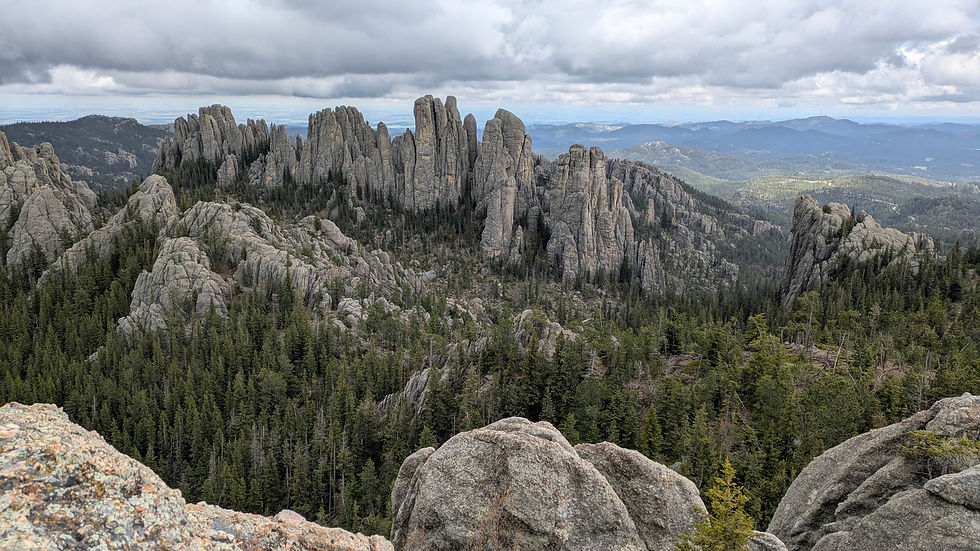
The afternoon was for hiking and the Little Devils Tower trail is a terrific 3 mile out and back trail that is rated as moderate. We really enjoyed this hike and it turned out to be one one of our best rocky forest hikes of recent memory. The Needles of the Black Hills of South Dakota are a region of eroded granite pillars, towers, and spires within Custer State Park and the views of the Needles during this hike were spectacular. It felt right to sit for 10 minutes of pure silence at the summit to really take in the beauty all around us.
Day 5 was an all-day immersion into the otherworldly landscape of Badlands National Park. Our adventure began with a brief stop in the town of Wall to explore the famous Wall Drug, a sprawling, interconnected series of stores that sells everything from donuts to souvenirs to an impressive assortment of Western wear including cowboy boots, hats and belts. From there, we made our way into the park, where we were immediately greeted by a herd of 6 to 8 bison. Relaxing and grazing, they crossed the road directly in front of our car, providing another intimate experience with these majestic animals.
The park's stunning scenery is a testament to millions of years of geological change. The craggy, multi-colored outcrops that dominate the landscape, with their striking resemblance to "multilayered sandcastles," are the result of time. Millions of years ago, this entire area was a seabed. After the sea receded, it became a lush subtropical forest, but over time, erosion by rivers and wind began to sculpt the dramatic buttes, canyons, and spires we see today. The rocks themselves were deposited as early as 75 million years ago and began their incredible transformation about 500,000 years ago. This process continues today, with the Badlands constantly eroding at an estimated rate of one inch per year, a fact that contributes to the unique and ever-changing features of the landscape.

Making stops at over half a dozen different viewpoints along the Badlands Loop Road, we took in the scenery from every angle, even climbing over and around some of the buttes at the Pinnacles Overlook. In addition to our up-close encounter with the bison, the park's diverse terrain offered plenty of opportunities to see other wildlife. Throughout the day, we spotted bighorn sheep, hawks, and countless prairie dogs.
We completed two short but challenging hikes that offered incredible panoramic views. The Saddle Pass Trail, a steep 0.7-mile climb, took us about 30 minutes to summit and rewarded us with an amazing vantage point overlooking the White River Valley. Even more memorable was the Notch Trail. This 1.25-mile, 1.5-hour hike took us through a winding canyon and up a rope ladder affixed to the rock face to a ledge with some of the best overall views in the park. The experience of walking through the canyon and the striking differences in color, texture, and shape of the rocks made the Notch Trail a true standout—though it's not a hike I would recommend for someone with a fear of heights.
The name "Badlands" reflects the difficult terrain that challenged early explorers and settlers, but for us, the day was an unforgettable experience exploring this unique landscape.

Day 6 was Custer and Sylvan Lake after our early morning experience at Jewel Cave National Monument. Sylvan Lake is often considered the crown jewel of Custer State Park, offering a lodge, canoeing and kayaking options and numerous hikes which can be accessed via the Sylvan Lake Trail, an easy 1 mile hike that goes around the lake. The lake itself is pristeen with needle like mountains both within and around the lake. Its popular and therefore a busy place, buts it's tranquil and beautiful reminding me of Devils Lake, Wisconsin and a smaller version of Moraine Lake in Alberta, Canada. My wife enjoyed a walk around the lake and kayak ride while my son and I took in yet another terrific hike on the Sunday Gulch Trail (4 Miles, 3 Hours, Moderate, 776 Feet climb).
What a hike! We made many creek crossings and navigated in and around huge boulders and towering trees, surrounded by granite rock walls. This hike was different than our hikes at the Badlands and Little Devils Tower in Custer State Park. It combined scrambling over and around rocks with walks through heavy forested trails, with some incredible views of the Needles around us. This made for some of our most complete photos of the trip given the blue skies and 65 degree sunny weather.


Comments