

Taste the World: 22 Must-Try Ethnic Dishes
- chrissarcletti
- Nov 19, 2025
- 18 min read
Updated: Feb 4

This post gets into the details, including the history, of some of my favorite food items that I've enjoyed over the last 25 years. Most of the specific dishes I note I've discovered while visiting ethnic restaurants in Chicago and the Chicagoland area or during the course of my travels across North America and throughout parts of Asia, Europe and South America. Many of the items I note I was first exposed to in a market, hawker food stall or in some hole in the wall local restaurant I managed to find. Whether it be in the Chicagoland area where I live in, or during my travels to places like New York City, Saigon, Toronto, Mexico City or Singapore, I always end up in the same kind of places that serve the kinds of dishes featured in my post below.
I have included a brief history of each of the food items covered, in addition to pictures and at least a few places I recommend where you can find these delicacies in the Chicagoland area.
The dishes I list and describe in this post cover many cuisines and cultures. These are the food items I seek out at home and while traveling. They are the ones I'm willing to drive an extra 15 to 30 minutes out of my way to enjoy.
Happy tasty reading!
-----------------------------------------------------------
Pierogi
Pierogi are filled dumplings made from unleavened dough, commonly associated with Central and Eastern European cuisines, particularly Polish. Their exact origin is debated, but they likely originated in Asia and spread to Europe during the Middle Ages. Pierogi became a staple in Polish cuisine by the 17th century and were brought to North America by immigrants and became popular in areas with large Polish and Ukrainian populations.
Pierogi fillings vary from sweet variations filled with fruit to savory ones filled with sauerkraut, potatoes, cheese and ground beef. I prefer savory pierogis and particularly enjoy them pan fried with onions (and sometimes diced ham or smoked sausage). Kasia's is a popular brand available in many Chicagoland grocery stores and some restaurants well known for the dish include Tata's Pierogi in Elk Grove Village, Barbara's Polish deli in Addison and either Staropolska or Pierogi Kitchen in Chicago.

Empanadas
Empanadas have a rich and varied history, believed to have originated in Spain during the Middle Ages. They were initially created as portable meals for soldiers and miners, made by wrapping bread around a stew or filling. The name "empanada" comes from the Spanish word "empanar," meaning to wrap in bread. The concept of empanadas is thought to have been influenced by Arabic meat pies, introduced to Spain by the Moors.
The dish spread to Latin America with Spanish colonizers and during my travels in Brazil, and particularly Argentina, I became very familiar with them. Like pierogi, the fillings vary, though a combination of meats, cheeses and vegetables is most common. Some of my favorite empanada variations include those filled with seasoned ground beef, olives, onions and peppers and spinach and cheese. The accompanying chimmichurri sauce, ubiquitous with empanadas, elevates the dish to a level nearly unsurpassed. Chimmichurri is commonly made with olive oil, red wine vinegar, garlic, red pepper flakes, finely chopped parsley, and dried or fresh oregano. I prefer baked to fried empanadas and some of my favorite places to enjoy them are at Savory Crust (Carol Stream and Morton Grove), 5411 Empanadas (Chicago) or at any Argentinian restaurant (Tango Sur and Folklore in Chicago are my favorites).

Ćevapi
Ćevapi are small, grilled sausages made from a mix of minced meat (beef, lamb, or pork), salt, pepper and paprika. Onion, garlic, baking soda and egg whites are often mixed into the meat mixture and they are served with pita bread or, even better, a Balkan flatbread called lepinja. The main condiments include raw diced onions, and ajvar, a popular Balkan condiment or spread, typically made from roasted red peppers and eggplant, garlic, oil, and sometimes vinegar and spices.
Also known as ćevapčići, this is a staple Balkans dish, particularly in countries like Bosnia and Herzegovina, Croatia, and Serbia. The dish's history is deeply tied to the Ottoman Empire's influence in the region. The term "ćevap" derives from the Persian word kebab, meaning "grilled meat," which was adopted by the Ottomans and introduced to the Balkans during their rule (15th–19th centuries).
Some good places to enjoy this dish in Chicago include Beograd Cafe, where you can enjoy them in the restaurant or can buy them in the adjoining market to grill at home, and D4 Cafe in the Lincoln Square neighborhood. Rosemary, a top notch restaurant in the popular Fulton Market area, also does a great Ćevapi.

Focaccia
Focaccia bread is a traditional Italian flatbread with ancient origins, believed to have been created by the Etruscans of North Central Italy or in Ancient Greece before the Roman Empire.
Initially unleavened, focaccia evolved to include yeast, olive oil, and various toppings like herbs, cheese, and onions. Romans spread focaccia throughout their empire, popularizing it in regions like France and Spain.
This bread is chewy and delicious, making it almost a meal in its own with ingredients often baked into the bread. It's terrific warm out of the oven if your lucky enough to have that experience. Some places I recommend in the Chicagoland area for focaccia include Firenze Italian Street food and Damato's bakery in Chicago, Pronto Italian Sandwiches in Hinsdale and Eataly in any city where they have one of these terrific emporiums to Italian cuisine. Arrosto Delicatessen in Sheboygan, Wisconsin also does some terrific focaccia.

Baguette
The baguette is more than just a food item, loaf of bread, base for a sandwich or accompaniment to so many wonderful things (mussels and their beautiful broth and charcuterie and cheese plates are two of my favorite ways to use a baguette). The baguette is a symbol of French food and is a staple, along with croissants, at any French bakery across the globe. They are also a Vietnamese staple food item (see the Bahn Mi entry below).
Baguettes are made with only flour, salt, water, and yeast and are best eaten immediately, and definitely within 24 hours of when you purchased your baguette. It's common in France to grab a baguette from a local bakery on the way back from work, making it a regular part of daily life. My favorite places for baguettes are Floriole (Lincoln Park in Chicago) and Publican Quality Bread (Chicago Fulton Market and Oak Park), but any French bakery (Paris Baguette, Tous Les Jours, etc.) usually does a good baguette. The ones you get from grocery stores also do the job. At Floriole, they use their terrific baguettes to make one of my favorite sandwiches on earth, the simple but elegant Parisian (half of a baguette with grainy mustard and European style butter, smoked ham, and aged cheddar).

The Cubano
The Cubano, or Cuban sandwich, is a pressed, griddled sandwich that originated from Cuban immigrant communities in Florida, reflecting the shared history of Cuba and Florida. Built on Cuban bread—crispy on the outside and airy inside—it’s traditionally layered with roast pork, sliced ham, Swiss cheese, dill pickles, and yellow mustard, then pressed until warm, melty, and golden. What makes it stand out is the perfect balance between the tangy mustard and pickles and the richness of the meats and cheese, while the crisp, pressed bread provides the crunch that completes the experience.
The Tampa and Miami versions of the Cubano highlight how local influences have shaped the sandwich. The Miami Cuban stays true to its minimalist formula—ham, roast pork, Swiss, mustard, and pickles— while the Tampa version adds Genoa salami. This addition is a nod to the large Italian community in Ybor City, where the sandwich became a worker’s lunch in the early 1900s.
The best place to get a Cuban sandwich is at any Cuban restaurant, though Puerto Rican restaurants typically also do them well. The key is getting the bread right and while many gastro pubs and restaurants offer the Cubano, they often don't get the bread right. There are numerous Cuban restaurants in Chicago (1492 Cuban Fusion Cafe, El Cubanito, Havana Grill) and Cubano Brothers (Elk Grove Village, Chicago MetraMarket) is very good.

Bahn Mi
Bánh mì, meaning "bread" in Vietnamese, originated during the French colonial period (1887-1954) when the French introduced baguettes to Vietnam. Vietnamese locals adapted this bready food legacy the French left behind by filling them with local ingredients like pork, pâté, and pickled vegetables, creating a unique fusion sandwich. After the French departure in 1954, bánh mì evolved further, becoming a popular street food in Vietnam and later spreading globally as Vietnamese communities established restaurants abroad. Today, it is celebrated for its diverse flavors and textures, ranging from savory to spicy. These sandwiches typically feature lemongrass or ginger chicken, roast or grilled pork or tofu topped with pickled carrots and dailkon (radish), cilantro, sliced jalapenos and cucumbers. The toppings noted are essential and the sandwich (like the Cubano) is at its very best when the quality of the bread is top notch. Along with the Cubano sandwich, this is in my top tier of sandwiches.
You can find Bahn Mi at any Vietnamese restaurant, though my favorite spot for Bahn Mi is Nhu Lahn Bakery in the Lakeview neighborhood in Chicago. Ba Le Sandwiches on Broadway in Chicago (near Argyle), Lotus Bahn Mi (Oakbrook) and Noodles Pho U (Lombard) all do a solid Bahn Mi. For a full on Vietnamese experience, head to Argyle street in the Uptown neighborhood of Chicago (also known as Little Saigon or Asia on Argyle) where you can find Bahn Mi, Pho and any Vietnamese dish your heart desires at restaurants like Hai Yen, Miss Saigon and DaNang Kitchen.

Kimbap
Kimbap, also known as gimbap, is a Korean dish consisting of cooked rice and various fillings rolled in seaweed sheets. It has similarities to sushi but usually includes cooked vegetables (and sometimes meats) rolled with the rice with a touch of sesame oil and salt. It's a very popular lunch and snack food in Korea and is most often prepared at home or bought at a Korean market or grocery store. Typical ingredients included in these rolls are scrambled eggs, daikon (radish), zucchini or cucumber, carrots, spinach and sometimes bulgogi style beef. However, the beauty of kimbap is its flexibility and the varieties of this dish are nearly endless.
Kimbap is a healthy and delicious snack or addition to any meal and the best place to find it is at Asian markets like H Mart, Joong Boo Market or any Korean grocery store in your area. Apparently, even the movies, Netflix and KPop have decided to weigh in on the merits of kimbap, as the dish is mentioned in the KPop Demon Hunters film, which is Netlix' most viewed film of all time.

Falafel
Falafel is a beloved Middle Eastern dish made from ground chickpeas or fava beans, or a combination of both, mixed with herbs and spices and then deep-fried into crispy patties or balls. Its origins are debated, but many historians believe falafel traces back to ancient Egypt, where it may have been made with fava beans as a meat substitute during Lent.
Over time, falafel spread across the broader Middle East, with regional variations emerging. In Lebanon, Syria, and Palestine, chickpeas became the primary ingredient, giving the dish its modern form. Today, falafel is a staple street food in the Middle East and has gained global popularity for its flavor, versatility, and status as a plant-based protein option. It's typically served in pita bread with your pick of toppings or as part of a mezze platter. Typical topping include tahini (sesame seed paste), a diced cucumber and tomato salad, onions, pickles and hot sauce for those that likes things spicy.
You can find falafel at any Middle Eastern restaurant and it's typically reliably good. Some notable spots for falafel in the Chicagoland area are the Sultans Market locations in Chicago, Middle East Bakery & Grocery in Chicago's Andersonvile neighborhood and at any Pita Inn restaurant in the Chicagoland area.

Tavern Style Pizza
Tavern-style pizza originated in the South Side of Chicago in the 1940s after the Prohibition era (though Milwaukee begs to differ). Vito & Nick's is credited with creating the first tavern style bar pizza in 1946. The pizza was initially served in taverns as an enticement for patrons to drink alcohol.
Some key characteristics of tavern style pizza include how it's cut, in squares, making it easy to grab and eat (and making a plate optional). Tavern style pizza features a very thin, crispy crust with cheese spread to the edges, often made with a cornmeal-based dough rolled to 10-12 inches. In the past, this type of pizza was likely scene as just typical thin crust pizza, but tavern style pizza is now marketed to highlight its unique features (thin and extra crispy cracker crust, square cuts).
Nearly any pizzeria offers this style of pizza and if you want to ensure the crust stays crispy and isn't too weighed down by grease, ask for it extra crispy and go for only 1 meat topping (and focus on vegetables) instead of a meat lovers pizza. My favorite spots for Tavern Style Pizza include Kim's Uncle (in Westmont), Vito and Nicks (in Hickory Hills), Angelo's (in Downers Grove), Pat's (in Chicago) and Villa Nova (in Stickney or Lockport).

Cabbage Rolls
Cabbage rolls, known as holubtsi in Ukraine and sarmale in Romania, have a rich history dating back to ancient times. The earliest known recipes appear in a 5th century Roman cookbook, though the dish likely originated in the Middle East and spread to Europe through trade and migration. Today, cabbage rolls remain a cherished comfort food worldwide, though they are particularly popular in Eastern Europe and the Balkans.
The preparation techniques of the dish's key ingredient, cabbage, vary. The cabbage leaves can be used fresh, but are most often par boiled or pickled to make it easier to incorporate the fillings and roll them together. In my Croatian-American home growing up, the cabbage was par boiled and the fillings my mom used typically included rice mixed with ground beef or a combination of ground beef and pork. After the rolls were prepared, they were typically simmered in a tomato based sauce.
Cabbage rolls are a staple dish on any Polish or Ukrainian restaurant menu and they sometimes make an appearance on the menus at German restaurants. If they have them as a special, Danada Deli on Roosevelt Road in Wheaton has terrific cabbage rolls. They are also featured in the deli display at Gene's Sausage Shop and Delicatessen in the Lincoln Square neighborhood in Chicago.

The American Meatball (with a side of Spaghetti)
I know spaghetti is technically Italian and meatballs can be tracked to numerous cultures (including the Persian dish kofta - see below), but spaghetti and meatballs and meatball sandwiches are something (like Italian sausage sandwiches) that are pretty uniquely American. I don't remember ever ordering a meatball sandwich or spaghetti and meatballs in any
place I've visited outside of the United States. For some history, though........
The ancient origins of meatballs very likely started with the Persian dish kofta but evolved significantly through cultural exchanges with regions in Greece, North Africa and Spain. In America, the iconic spaghetti and meatballs dish was born from Italian immigrants who arrived between 1880 and 1920. These immigrants adapted their traditional recipes to include affordable ingredients like ground beef and canned tomatoes available in the U.S., creating a hearty and cost effective meal that could feed large families. This adaptation became a staple of Italian-American cuisine, distinct from traditional Italian dishes where meatballs are not typically served with pasta.
The best place to get a meatball sandwich is from any Italian market or deli near you that offers the sandwich. Along with an Italian cold cut sandwich, a meatball sandwich is an essential menu item at any Italian American deli. In Chicago, Bari Foods on Grand Avenue does a mean meatball sandwich as does Frankies Deli in Oakbrook and Mortadeli in Villa Park. Most Italian delis willing to put it on the menu don't do so unless it's a solid offering. As for spaghetti, just go to the pasta section of the menu at any Italian American restaurant.

Italian Sandwich
The Italian sandwich, often associated with Italian-American cuisine, traces its origins to Portland, Maine, where Giovanni Amato, an Italian immigrant, claimed to have invented it in 1902. Amato initially sold sandwiches from a pushcart, catering to dockworkers with fresh rolls filled with meats, cheeses, and vegetables. The sandwich gained popularity in various northeastern U.S. cities, evolving into different regional variations like the hoagie and submarine sandwich. Today, it remains a staple in delis across America and is particularly popular in Italian centric butcher shops and delis which offer their "Italian" sandwiches filled with some combination of salami, capicola, pepperoni, ham and mortadella with cheese (typically provolone), lettuce and tomato (onion is a necessity for me) and oil & vinegar or giardinera.
I've had some terrific Italian sandwiches in cities with large Italian American populations like Boston, Providence, New York and Chicago. Some recommended spots include:
Casa Della Mozzarella in Brooklyn, NYC
Gloriosos, Brady Street, Milwaukee, Wisconsin
Bari Foods, Grand Avenue, Chicago, IL
Finuccio and Sons, Schaumburg, IL
Mortadeli, Villa Park, IL
Pronto Italian Sandwiches, Hinsdale, IL
Bertos, Downers Grove, IL
Frankies Deli, Oakbrook Terrace, IL

Bari Foods Italian Sandwich
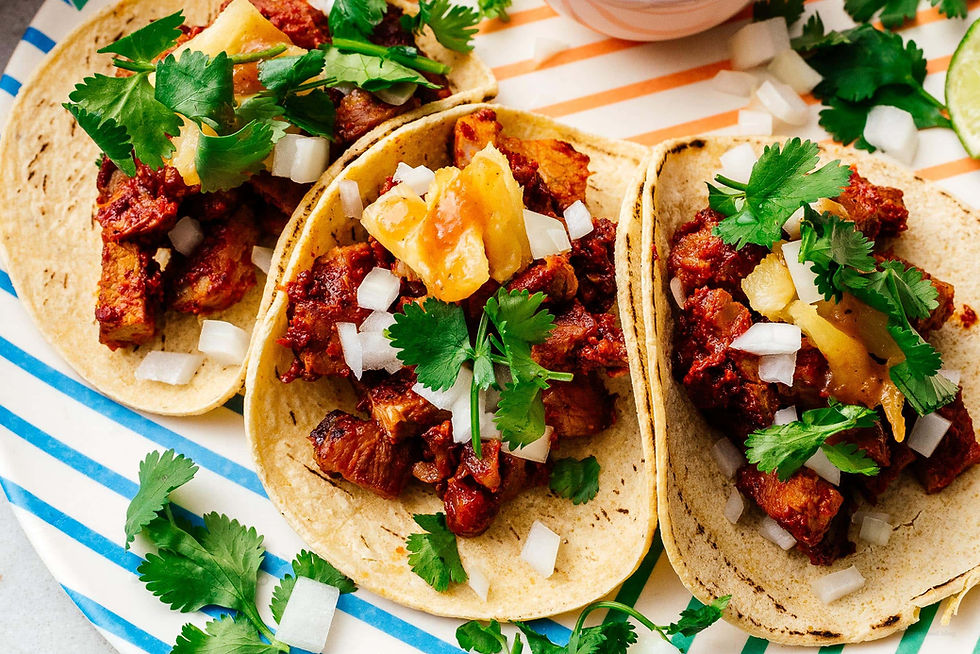
Tacos al Pastor
Tacos al pastor (closely related to shawarma), is a quintessential Mexican dish that originated in the 1930s in Puebla, Mexico, influenced by Lebanese immigrants who introduced shawarma-style cooking. Initially called tacos árabes, lamb was cooked on vertical spits and served with pita-like bread. Over time, pork replaced lamb, and the dish evolved with Mexican flavors like adobo marinade, cilantro, onions, and pineapple. This adaptation spread widely across Mexico, particularly in Mexico City, where corn tortillas became standard. The vertical spit (trompo) remains central to its preparation, creating the signature tender yet crispy meat.
My favorite spots for on the spit al pastor in the Chicagoland area are Taqueria La Herradura in Addison, Tacos Mario's in Chicago (near Midway) and any of the Taquerias Atotonilco locations (Chicago, Stone Park, Joliet).

Chaat
Chaat, a popular Indian street food, originated in Uttar Pradesh during the Mughal era, particularly under Emperor Shah Jahan in the 16th century. It was initially created as a medicinal dish with tangy and spicy ingredients to aid digestion. Over time, chaat evolved from royal kitchens to street food, adapting regional flavors and ingredients across India. Today, it symbolizes India's culinary diversity with countless regional variations like pani puri and bhel puri.
Any variation of chaat is good with the combination of flavors taking your taste buds all over the place (from sweet to sour to salty to savory). Ordering a variation of chaat that features samosas is a great way to add in another Indian street food favorite. Many variations include puri (bite-sized, deep-fried Indian bread) and sev (a popular Indian snack made from chickpea flour paste that's deep-fried into crunchy noodles). Some common variations of chaat I particularly enjoy include Pani Puri (crispy puris filled with spicy tamarind water, potatoes, and chickpeas), Papri Chaat (fried wafers, potatoes, chickpeas, yogurt, and chutneys) and Aloo Chaat (fried potato cubes mixed with spices and chutneys).
Annapurna (locations in Chicago and Hoffman Estates) has terrific chaat and many Indian restaurants offer a few variations of chaat, usually on their appetizer menu.

Spanish Tortilla
The Spanish Tortilla, or Tortilla Española, has a fascinating origin rooted in 19th-century Spain. The most popular legend related to the dish involves a Navarre housewife who, during a surprise visit from a Spanish Army General, created a simple dish using only eggs, potatoes, and onions. In those days, this dish was common as a nutritious meal for troops.
Historically, potatoes were not native to Spain, arriving from South America in the 15th century. It took over 200 years for potatoes to become a staple in Spanish cuisine and now they are a key component in one of my favorite dishes that feature the modest and mighty, but flexible to any spice or sauce, potato.
The typical recipe features eggs, onions and potatoes and often includes other additions. I particularly enjoy adding in some roasted garlic or pesto, along with spinach (or asparagus), onion and ham or bacon. The dish comes out much like a casserole, quiche or crustless pie making it amenable to any additions to the core ingredients.
Tortilla is a staple on any Spanish restaurant menu including at Cafe Ba Ba Reeba in Chicago and Meson Sabika in Naperville. It's also prominently featured on the menu at Curate, the best Spanish restaurant I've ever eaten at in the United States in Asheville, North Carolina.

Shawarma, Döner Kebab and Gyros
Shawarma’s story starts in the 19th-century Ottoman Empire, where cooks perfected the art of roasting seasoned meat on a vertical spit. This method evolved from older Middle Eastern grilling traditions, but the rotating spit was the breakthrough—it kept meat tender, evenly cooked, and ready for quick slicing. Lamb was the original star, though beef, chicken, and turkey joined the rotation as the dish traveled. It fit perfectly into the bustling markets of the time: slow-roasted meat that stayed hot and flavorful throughout the day.
As the Ottoman Empire dissolved and people moved across regions, they brought shawarma with them and found devoted fans in many countries including Lebanon, Syria, Jordan, and Israel. Here it developed into the wrap we know today, layered with garlic sauce, pickles, herbs, vegetables and hot sauce. One close shawarma cousin worth noting is the döner kebab—born in the same empire and sharing the same vertical-spit DNA. Döner became the dominant version in Turkey and later exploded across Europe, especially Germany, where it turned into a late-night food legend. Shawarma and döner are culinary siblings: same technique, different seasoning styles, each with a loyal global following.
Shawarma has had a sizeable impact on many foods from many cultures including Mexico (Al Pastor) and the Gyro (Greece). Gyros is also a culinary sibling to shawarma with different seasonings and toppings to reflect their respective culture. Shawarma features bold spices (e.g., cumin, turmeric) and hardly ever uses pork, while gyros are flavored with Mediterranean herbs (e.g., oregano, rosemary), are meat agnostic (beef, lamb, chicken and pork are used) and are paired with tzatziki sauce.
I recommend Cafe Istanbul, Sultans Market and Shawarma Inn in Chicago,
Hello Shawarma in Lombard and find Naf Naf Grill and Pita Inn to be solid and reliable fast casual chain restaurant options for shawarma. Taste Greek Street Food in Westmont does some terrific pork, chicken and beef/lamb spit roasted gyros.

Spinach Pie - Spanakopita
Spanakopita, the Greek spinach pie, has deep historical roots tracing back to ancient Greece. Savory pies were common in ancient times, initially prepared with various flour types and filled with legumes, cheese, garlic, and honey. Spinach originated in the Middle East and was brought to Europe during the Byzantine Empire and it eventually became a core part of any spinach pie. Spanakopita is very similar to borek (or burek) although burek often includes ground lamb or beef which is added to the core ingredients of the dish (spinach, feta cheese, onions, phyllo dough, eggs and dill or parsley).
Spanakopita is now ubiquitous in Greece, served in coffee shops, bakeries, and homes as an appetizer, snack, or light meal. You can find spanakopita at any Greek restaurant (or bakery) and some of my favorites are Naxos in Itasca, Greek Islands in Lombard and Chicago and Taste Greek Street Food in Westmont.

Spring Rolls
Fresh spring rolls have a rich history that traces back to ancient China when these thin "spring pancakes" filled with seasonal vegetables were eaten to celebrate the first day of Spring. Over time, these evolved into the spring rolls known today, and which are staples on the menus of many Thai and pretty much all Vietnamese restaurants.
In Vietnam, fresh spring rolls, known as "gỏi cuốn," are typically made with rice paper and filled with shrimp, pork, vegetables, vermicelli and mint. The fillings in spring rolls vary and they are often served with a dipping sauce. Typical dipping sauces include a creamy peanut butter version, a hoisin type sauce or my favorite, a nước chấm sauce which features fish sauce, lime juice, sugar, garlic and chili paste.
Any Vietnamese restaurant features spring rolls so check out any restaurant on Argyle Street in Chicago (see the Bahn Mi entry above for specific restaurants). Lotus Bahn Mi (numerous locations including in Oakbrook) and Noodles Pho U (Lombard, Bolingbrook, Naperville) also have terrific spring rolls.

Satay
Satay originated in Indonesia in the late 19th century, inspired by Arab and Indian kebabs brought through busy trade hubs on Java and Sumatra. Local vendors adapted the idea with regional ingredients—turmeric, coriander, garlic, and palm sugar—creating a smoky, slightly sweet street-food favorite that quickly became a staple across markets and roadside stalls.
As the dish spread, neighboring countries put their own spin on it. Thailand added a sweeter, coconut-leaning marinade and the well-known peanut sauce, while Malaysia and Singapore developed their own spice profiles and serving styles. Whether from a Bangkok vendor, an Indonesian warung or at a Thai restaurant in Chicago, satay still delivers the tender grilled meat and smoky simplicity that made it a regional classic.
Satay is a staple appetizer on the menu of any Thai, Malaysian or Indonesian restaurant and is eaten casually (often over drinks) in outdoor restaurants and markets throughout Singapore and Malaysia. My favorite Chicagoland spots for satay are Serai and Andy's Thai Kitchen in Chicago and Penang Malaysian Cuisine in Arlington Heights.

Portuguese Custard Tart
The Portuguese custard tart, or pastel de nata, dates back to the early 18th century in Lisbon. It was first created by monks at the Jerónimos Monastery in Belém, who used egg whites to starch laundry, leaving excess yolks. To avoid waste, they used the yolks to make pastries—one of which became the custard tart. When the monastery closed during Portugal’s liberal revolution in the 1820s, the monks sold the recipe to a nearby sugar refinery. Its owners opened the Pastéis de Belém bakery in 1837, which still operates today and guards the original recipe closely.
Over time, the pastel de nata became a cornerstone of Portuguese café culture and a symbol of the nation’s cuisine. Its popularity spread through Portuguese migration to Brazil, Macau, and beyond, with each region adapting it—Macau’s version has a caramelized top and flakier crust influenced by British tarts. Whether enjoyed with an espresso in Lisbon or at a bakery in Toronto or Hong Kong, the pastel de nata remains a global pastry icon.
You can find these tasty tarts at one of Chiu Quon Bakery's two locations (Chinatown and Uptown) or at the terrific Noodlebird in Logan Square.

Kofta Kebap
Kofta kebap, a dish with ancient origins, traces its roots back to early Arab and Persian cuisines. The term "kofta" is derived from the Persian word "küfte," meaning "pounded meat". Early recipes appeared in Arab cookbooks, featuring ground lamb meatballs glazed with saffron and egg yolk. The dish spread across the Middle East and Central Asia, with each culture adding its own variations. In the Ottoman Empire, kofta became a popular dish, particularly in the kitchens of Topkapı Palace. Today, kofta kebap is enjoyed worldwide, showcasing diverse regional adaptations.
These kebaps are similar to meatballs and are typically made with beef or lamb (or a combination of the two), though chicken is sometimes used. The seasonings used vary (cumin, coriander, garlic, parsley, other seasonings) and the meat mixture is shaped into longer kebaps which are usually grilled. They are typically eaten encased within a lavash or pita wrap and topped with vegetables and either hot sauce or garlic sauce.
This dish is popular at most persian and middle eastern restaurants and I enjoy them at Pita Pita in Lombard, Nay in Glendale Heights, MazMez in Elk Grove Village, Kabobi in Chicago and Noon O Kabab in Chicago.

Well done! I am excited to try some of these places. You shared such great information!